|
Yaxhá, The Site of Survivor Guatemala
By Lisbeth Holt
Floodlights of fame have been thrust upon the ancient city of Yaxha, the third largest Maya site in Guatemala, exceeded only by the sites of Tikal and El Mirador. The captive of Peten jungle’s unyielding embrace for well over a thousand years, it had been all but forgotten by the world. Directors, actors and camera-men, the cast of "Survivor", CBS’s fabulous reality show, now swarm over this vast, mysterious site, facing the unsolvable riddles of its existence. The name "Yaxha" will be on thousands of lips now, the images of its haunting beauty beamed into countless homes.
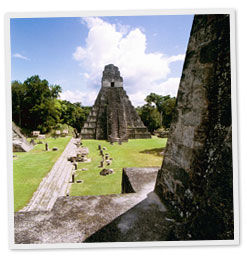
The enigmatic Maya built this city without sophisticated tools, even without the aid of the wheel. They moved immense boulders from limestone quarries and formed them into soaring temples, set in precise alignment with the movement of celestial bodies. Their mathematicians, astronomers, architects, artists, had the incomprehensible abilities to tame the jungle, to create a complex community for a population of thousands in these formidable surroundings, so very long ago. They created an intricate amazingly accurate calendar, correlating each day with certain characteristics. This site may well be where scribes further developed their cryptic written language. History is awed by these superbly ingenious people, those who devised these phenomenal cultural concepts. Some theorize that perhaps the flattening of their foreheads soon after birth, a common Maya practice, modified their thinking! Did that compression somehow give the brain more power, unite the right and left hemispheres for a higher intelligence and purer grasp of the universe?
German archaeologist, Toebert Maler, was first to explore this site in 1904, taking some amazing photographs. Its remote location in the Maya Biosphere Reserve is just several miles southeast of Tikal. Yaxha thrived for some six hundred years in the Classic Period, A.D.300 - A.D. 900. The influence of mighty Teotihuacan seems to indicate that these mysterious people fled southward from central Mexico to settle here. Its architecture and the vast network of streets and sidewalks are similar, and a stela depicts a warrior-goddess wearing a Tlaloc (rain god) mask. The twin pyramids in Plaza A Complex resemble those in Tikal, believed to have been an ally.
Yaxha, "jade-colored water" in Nahuatl, is the only Mayan city to have retained its original name. The toponym implies the significance of the site, as jade, the precious, green stone symbolic of life, was held in higher esteem than gold. Green also the staff of life, maize, and the prized feathers of the elusive quetzal ( the finest emerald-green gem was called quetzalitzli!) favored by the nobility.
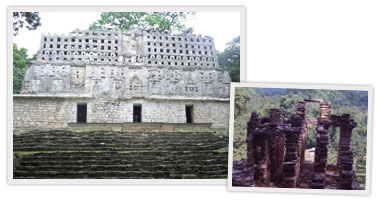
Situated on the northern ridge of beautiful Lago de Yaxha, the pinnacle of Pyramid 216 affords unforgettable vistas, especially at sunset. This tallest pyramid, rising in tiers, is the only major structure uncovered to date, and others are being restored. Fascinating interior artwork depicts a procession with an extravagantly-dressed personage accompanied by an entourage including standard bearers and a musician. Five hundred structures remain hidden within a maze of tightly-knit vegetation in nine plazas.
Moreletti crocodiles paddle within the lake’s gleaming folds. In its center, the island of Topoxte reposes with its archaeological treasures, another of many inexplicable riddles! The temples, the ruined observatory, even the stelae, are perplexingly diminutive, child-size. Could this have been a playground for the children of the nobility? Perhaps a band of wily dwarfs resided here. After all, legend has it that Uxmal was created by a magician dwarf. The dwarfs may have had inestimable power at various sites!
The ancient temples silently speak of Yaxha’s mysterious past. Archaeologists are able to decipher the complexities of this ancient society from the design and workmanship of its architecture, the alignment of temples, the artistic representations of their rulers and gods, the massive stelae, the ball-courts and roadways. One incredible discovery leads to another as more of these fabulous treasures are painstakingly brought to light.
Faced with the same forces of nature as we face today: cataclysmic earthquakes, raging hurricanes, fearsome floods, destructive droughts, the Maya priests interceded with the gods to alleviate fear and uncertainty among the populace. The priest-king was a living symbol of the gods of creation and destruction, the direct conduit with the heavens, and demanded strict obedience to his dictates. The people believed that in obeisance, continuity, order and harmony would prevail.
The Maya ruling dynasty sought to understand and predict events with their calendrical system, mapping the constellations, ascertaining the change of seasons and the proper time to plant their seeds of maize. They sought portents in the movement of the planets, the direction of the winds, the abundance of wildlife. Magic and divination were supremely important and considered to reveal knowledge of a higher order. Their dreams and perhaps hallucinations were interpreted as predictions of future events.
Why they abandoned their fabulous city and where destiny next led them remains a mystery. They left no discernible trace. Perhaps they vanished into a dimension present even now, but unknown to us! One’s imagination runs as wild here as the sounds of the jungle’s inhabitants when night falls. The spider and howler monkeys are alive and well!
Yaxha’s bosom is heaving under the steps of twenty-first century’s seekers of the exotic, and those in search of meaning amidst the upheavals of today. Will its age-old secrets be revealed? Its aura of magic shattered by the glare of an uncomprehending gaze? Intrusion into its most sacred places may well be impossible. Perhaps the ancient resident spirits protect this realm in unknowable ways.

Astounding Yaxha is included in both Mayatour’s Maya Classic Tour and Maya Odyssey Tour!
For travel to this exotic destination, contact Mayatour:
800-392-6292
info@mayatour.com • www.mayatour.com
|