| |||
|
SPECIALS · TRAVEL TIPS · ABOUT MAYATOUR · CONTACT · HOME · LINKS | | |
| | ||
| Mexico · Belize · Guatemala · Honduras · El Salvador · Nicaragua · Costa Rica · Panama · World of the Maya | | ||
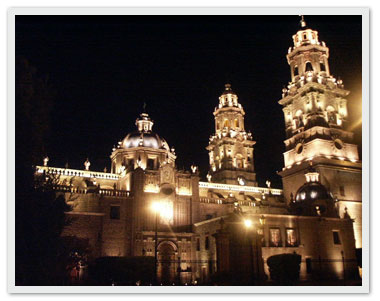
As we approached Morelia, the capital of the state of Michoacan in western Mexico, we suddenly began to understand why this state is called "the soul of Mexico." There before us in the distance, we viewed the Cathedral’s lofty twin towers like luminous sentinels in the city center. What stroke of genius inspired the Morelianos to set the magnificent Cathedral ablaze with light when night falls? You can attribute it to the soul underlying such decisions. Michoacan is no ordinary state. Michoacan is an Indian word meaning "land of the fisherman." Reputed to be the most picturesque of the Mexican states, it has more lakes than any other. Much of the state is dominated by a volcanic mountain range, the Cordillera Neovolcanico, and has rich volcanic soil. A bountiful cornucopia of fruits and vegetables thrive in the area. Avocado plantations abound.
At an elevation of 6,000 feet, Morelia, "the aristocrat of colonial cities", was founded in 1521 by Antonio de Mendoza. Originally named Valladolid after Mendoza’s hometown in Spain, the name was changed in 1828 to honor Jose Maria Morelos, a heroic priest-fighter for Mexican independence. It has been named a World Heritage site by UNESCO; a designation given solely to those sites considered to be of outstanding universal value. Because most of the buildings in the historic center are constructed of pink sandstone, it is also called "the city of pink stone." Clean wide boulevards with colonial style buildings from the 17th and 18th centuries entice you to explore on foot and marvel at history seemingly come alive. The Plaza of the Martyrs and the Plaza Valladolid are situated next to the ancient Cathedral. It took a century to complete the cathedral, 1640 - 1740, considered to be one of Mexico’s loveliest. It was here in the Plaza of the Martyrs that the rebel priests were executed in 1810 for their part in the revolt which eventually resulted in the overthrow of Spain. It is here, next to the glorious Cathedral in its veils of light, that festive celebrations are held every Saturday night. You may see incredibly imaginative ballet performances or splendid marching bands in this magnificent arena of the arts. The Michoacan Museum, the Museo Casa Morelos museum, and the Casa de las Artesanias housed in the former convent of San Francisco are places you may wish to explore. The latter is a museum and marketplace filled with handicrafts created by talented artisans of the state: intricately lacquered wooden trays and boxes, pottery of innumerable shapes and colors; textiles, copperware, metalwork, furniture; choosing what to purchase is the difficult part. You will be amazed by the ancient aqueduct, a stunning feature of the city. Built in 1785, it brought water to the city’s inhabitants. Standing some 30 feet high, consisting of over 253 arches, it stretches nearly a mile and is beautifully lit at night. It begins at the city’s largest park, the Bosque Cuauhtemoc, and ends in the Plaza Villalongin. Here you will find the famous fountain, a symbol of Morelia, of three Tarascan Indian women holding aloft a huge basket of fruits and vegetables. You may see the marvelous statue of Jose Maria Morelos on horseback, one of the horse’s feet raised to indicate the rider’s death. A time-capsule from 1910 has been placed here, to be opened in 2010 revealing the life of those times! The Government Palace’s interior walls are covered with wondrous murals by the revered Michoacan artist Alfredo Zalce. You may also see Zalce’s dramatic work in the nearby "treasure" of a hotel, the Casa de la Loma ("House on the Hill") , in addition to soulful sculptures by Pancho Ramirez, another local artist of great talent. Originally a 17th century bishop’s place, Hotel Los Juaninos, next to the Cathedral, was recently restored to splendor with its well-appointed rooms and suites. On a Saturday night, you can sit on the top floor terrace to enjoy your cocktails. As night falls, soft gold and pale green lights gradually envelop the Cathedral to sounds of celestial music. And it may be your good fortune, as it was ours, to see spectacular fireworks light up the sky. Exquisite La Casa de las Rosas, with its four eclectic suites, can be found just a block from the main square. Originally an ancient, aristocratic Morelian home, it was recently converted to a luxury property with a small, quaint restaurant. Here you will be transported to a place of true romance! After leisurely sightseeing, you may seek out the region’s fine gourmet restaurants, some of which are "treasures" as well. On the evening that we arrived in Morelia, we dined on superb fare at whimsically decorated Los Miguelitos which combines art and gastronomy. Museum quality art is literally everywhere. Hundreds of upside-down Saint Anthony figures can be found in the "Old Maid’s Spot" dining area. Almost everything is for sale here. Elegant Los Mirasoles in a colonial manor house, is a feast for the senses. In addition to its unusual delectable foods, the wine cellar boasts an extraordinary selection of wines. This avant-garde restaurant has monolithic pillars and arches, one of the ceilings painted in celestial blues, and hand-made furniture. Will you lunch on Tarascan soup, or corundas and uchepos? "Capones" chiles, and leg of pork in Morelian pulque marinade? For dessert, do try the"delicia mirasoles", a puff pastry with fruit jelly, cheese and incomparable blackberry coulis. Picturesque lakes teeming with succulent fish grace Michoacan. Lake Patzcuaro, the highest body of water in Mexico at 7,000 feet above sea level, lies thirty minutes west of the capital, near the city of Patzcuaro. Justly famous for its butterfly-net fishermen and the delicate pescado blanco (white fish). The air is cool and invigorating in the city of Patzcuaro. This is the spiritual center of Michoacan , largely inhabited by the Tarascan Indians. Their language called Purepecha has no known relation to other languages. It may have roots of the Quechua language of the Incas. As we drove toward the city center, we began to experience an inexplicable peace of mind and tranquility. It must have something to do with that Mexican soul! Here its presence is palpable. The main plaza, Plaza Vasco de Quiroga, is filled with towering ash trees and is illuminated at night by lanterns (faroles). Splendid old hotels and enticing shops surround the plaza, with a statue of Quiroga placed in its center. In the 17th century Basilica de Nuestra Senora de la Salud, you can see the Virgin of Health, created by the Tarascans out of corn paste and wild orchids. Revered throughout Mexico, it is thought to have great healing powers. You will find the Plaza Gertrudis Bocanegra, also called Plaza Chica, two blocks away down cobblestone streets. This Indian marketplace was named after the illustrious woman who fought for independence from Spain and refused to name her co-conspirators. She was executed by a firing squad in 1818. She ia commemorated by the bronze statue in the center of this square. Facing the plaza is the Biblioteca (Bocanegra Library), the former San Augustin monastic church, which houses a panoramic mural painted by Juan O’Gorman in 1942. The mural depicts the tumultuous history of Michoacan from Tarascan times through the 1910 Revolution. It also honors Erendira, the first Indian woman to mount a horse, and to rally allies against the monstrous Nuno de Guzman. Before Guzman arrived into this area in 1521, it was known as a pilgrimage center sacred to the Tarascan kings of Michoacan. It had been founded around 1325 and was known as the "gateway to heaven." The Tarascans were a fiercely independent people, never having been conquered by the mighty Aztec empire. Guzman barbarously terrorized the populace. Word of Guzman’s brutal treatment of the Tarascans eventually reached the government in Spain. They sent Bishop Vasco de Quiroga to alleviate the situation in 1536. His battery of artisans taught the Indians in the villages around Lake Patzcuaro home crafts which have been passed on successfully from generation to generation. There are the coppersmiths in Santa Clara del Cobre, artists in silver in Patzcuaro, woodcarvers in Janitzio, guitar-makers in Paracho, and basketweavers in Tzintzuntzan! Visiting these craft villages will reward you with extraordinary experiences. You can view opalescent Lake Zirahuen on your way to Santa Clara del Cobre. Legend has it that the tears of a star-crossed lover created this late. In the village, artisans create beautiful objects in copper: vases, pitchers, plates, candlestick holders, bells, even jewelry! You’ll be able to see them at work, firing heavy chunks of copper with bellows until red hot, then hammering them into shape. The city of flowers, Uruapan, is within an easy drive from Santa Clara. The Eduardo Ruiz National Park is a wonderland of nature. Exuberant vegetation, waterfalls and especially Rio Cupatitzio which meets your eyes like a beautiful river of dreams; rushing, foaming, gleaming. Brave divers plunge from bridges into the seething waters below. As you walk gingerly through the park over the stoned stair and pathways, you emerge next to the Mansion la Cupatitzio on its magnificent site. Great food awaits in the cheerful dining room; the spacious guest-rooms are adorable and welcoming. The suite-is-to die-for! In Patzcuaro, we met at the La Posada del Basilica for Margaritas in the courtyard around a blazing fire. It was here we enjoyed the most divine Margaritas we’d ever tasted! We adjourned to the upstairs dining room with a view of the Basilica for a fantastic dinner, and were feted with live music by a talented singer with strumming guitar. The guest-rooms looked very inviting, many with fireplaces. We discovered the hotel La Mansion de los Suenos, a marvelous hostelry, just steps from the plazas. A classic 17th century mansion converted into an avant-garde hotel in 1998, the opulent suites take your breath away. Relax by a cozy fireplace as you make plans for more sightseeing! Dine in an exquisite dining room with impeccable service and fine cuisine. Hotel Mansion Iturbe is a refurbished mansion replete with antiques and artworks. Some of the delightful rooms have balconies overlooking the main plaza. One of the hotel’s two restaurants has live music in the evenings. Coffee and desserts are served in the traditional portals. From Michoacan, you may well continue on to other fascinating colonial cities such as famed San Miguel de Allende and Guanajuato, in nearby Guanajuato state; or Guadalajara, in Jalisco state; or west to the Pacific resort towns of Ixtapa and Zihuatanejo, in Guerrero state. These cities, too, share in the soul of Mexico, but quite possibly, it is enchanting Michoacan which will capture your heart! 
|
|
|